


The brief but brilliant career of US chemist Alice Ball, who brought hope and new life to thousands of leprosy patients in the 20s and 30s, was almost lost to history, but a recent film highlights her life-changing work.
The short film The Ball Method dramatizes the story of an unsung hero who pioneered the first effective treatment for leprosy but died before she could publish her findings. A senior colleague then claimed her work as his own, and Alice wasn’t recognized for her discovery for half a century.

Ethiopian-born American writer and director Dag Abebe says he discovered Alice Ball’s inspiring story while undertaking research for his thesis film in the University of Southern California (USC) School of Cinematic Arts MFA Program.
“Before my film graduate school, I was a physics major at the University of Virginia, so when I found out about Alice’s story, I was amazed at how people had never heard about it. I also saw it as a good opportunity to combine my science background with film,” he explains.
“The fact that she was a Black woman in 1915 Hawaii and able to accomplish such a feat was remarkable to me. I was the same age as her when I found out about her story, so I was astonished by how much she was able to accomplish by then!”
Born into a prosperous African American family in Seattle in 1892, Alice Ball earned two bachelor’s degrees in pharmaceutical chemistry and pharmacy science from the University of Washington by 1914. The same year, she co-wrote a paper on benzoylations in ether solution that was published in a prestigious scholarly journal—a rare feat for a woman at this time, let alone an African American.
In 1915, Alice became the first woman and the first African-American person to receive a master’s degree from the University of Hawaii and to teach chemistry there. Later that year, she became head of the chemistry department.
As a postgraduate, Alice researched the chemical makeup and active ingredients of kava root. So, in 1915, when Alice met Dr Harry Hollmann at Kalihi Hospital in Honolulu, he enlisted her to help develop a treatment for leprosy using the oil from the seeds of the chaulmoogra tree, a traditional folk remedy for leprosy with ancient roots in India and China.
This oil had been tried as a lotion but was too sticky to be absorbed. It had been given orally, but patients would vomit it out because of its vile, acrid taste. The only way to make it effective was to make it injectable. However, the injection was agonizing for the patient, and the unprocessed oil ulcerated the patient’s skin and created unsightly blisters.
Alice accepted the challenge. After cracking the complex chemical code in the oil, she identified its two main components—chaulmoogric and hydnocarpic acids—and converted them into fatty acids. Then, during a eureka moment, she realized the acids needed to be frozen overnight to give enough time for the ethyl esters to separate and to stop them from degrading at room temperature. The result was a water-soluble form that could be absorbed into the bloodstream without harm. It was a revolution in leprosy treatment and the closest anyone came to a cure until the development of antibiotics in the 1940s.
Ball’s Method was very successful. By 1918, 78 people with leprosy at Kalihi Hospital who received this treatment were free of lesions and were able to reunite with their families. Between 1919 and 1923, no new patients were exiled to Molokai.
But Alice never got to see the results of her work. She died six months after returning to Seattle on 31 December 1916, aged just 24. It is believed she was poisoned by chlorine gas while giving a demonstration on how to use a gas mask, possibly a result of insufficient ventilation.
A senior colleague, Arthur Dean, capitalized on her research by naming it the Dean Method, and it took the University of Hawaii 90 years to recognize her work.
The 18-minute film, The Ball Method, begins with heartbreaking archival footage showing a distressed child covered in facial sores and fingers blunted by lesions.

The story begins with a young boy who arrives at Kalihi Hospital in Honolulu, desperate to avoid the fate of being sent to Molokai, the island where, from 1866, the Hawaiian government forced thousands of people with leprosy to live in isolation until they died. Back then, leprosy was a highly stigmatized condition, and people feared it was highly contagious, though now we know it is not.
Motivated by her compassion for the young boy, Alice (played by Kiersey Clemons) stands up against a senior colleague who wants her to focus on cleaning up the stockroom and burns the midnight oil, eventually finding the solution to save the boy from the death sentence of being sent to Molokai.
“I wanted to focus more on her ambitious personality and determination,” says Dag.
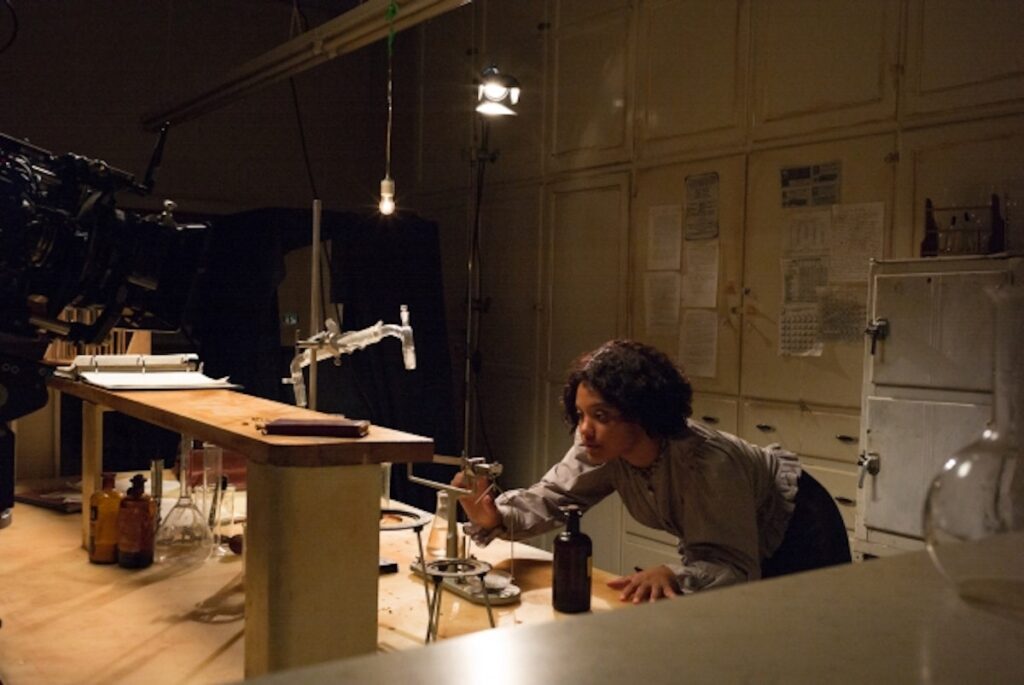
“In real life, she never really got to see her results, but in the short film, I made it so she gets to see her results. That’s the tragedy, that she didn’t get to see that she helped bring back so many people who were exiled and reunite them with their families,” he said.
The Ball Method won the Jury Award for Best African American Student Filmmaker from the Directors Guild of America and played in various film festivals such as the Pan African Film Festival, Sarasota Film Festival, and the Honolulu African American Film Festival.
Dag now lives and works in Los Angeles, directing commercials and music videos and editing feature films while writing and preparing to make a longer version of the Alice Ball story.
“I currently have the latest draft of the feature film version of Alice Ball’s story written. We are currently searching for investors and funding to make this a reality!”
With the short film available on Amazon Prime, but only in the US and Canada, Dag Abebe says he is happy to send a private screener of The Ball Method to any group that would like to organise a viewing. You can contact him on dagmawiabebe19@gmail.com
Trigger warning: The 18-minute film, The Ball Method, begins with heartbreaking archival footage showing a distressed child covered in facial sores and fingers blunted by lesions. It also includes confronting historical footage of a large syringe being inserted into a patient’s back.
Movie stills used with permission of Dag Abebe.


Subscribe to our newsletter and keep up-to-date with Leprosy Mission Australia
By clicking Subscribe you're confirming that you agree with our Terms and Conditions